01 / SUPPLY
Make existing space useful again.
Cancel a booking you no longer need so another colleague can use the space. A desk held just in case can look unavailable even when nobody intends to use it.
A better booking culture
Book around the days you need, the space that works for you and the people you work with. DeskIQ brings your routine and changing plans together, making it easier to book with purpose and cancel when you no longer need the space.
Automatic allocation for your routine. Waiting lists for changing plans. An approach to team days that follows the week you're actually having.
Break the booking cycle
An early booking window. A busy office day. A team whose plans are still moving. It's easy to reserve a few possible days now and decide later.
When enough people do that, reservations stop being a clear picture of demand. Colleagues see a full office, hold on to their own options and keep checking for space. The booking process starts shaping the working week.
DeskIQ gives people tools to plan ahead and respond to change, so holding extra reservations becomes less necessary.
Behavioural illustration · An explanation of the cycle, not a measured customer result.
Supply. Demand. Culture.
01 / SUPPLY
Cancel a booking you no longer need so another colleague can use the space. A desk held just in case can look unavailable even when nobody intends to use it.
02 / DEMAND
Your routine expresses regular plans. Weekly changes and waiting lists add context about the days you still need, rather than encouraging reservations for every possibility.
03 / CULTURE
Automatic booking and a clear route for changing plans reduce the need to organise your morning around a booking window. The aim is to make defensive reservations less necessary.
DeskIQ helps existing space respond to real plans. It cannot create extra desks on a day when every suitable place is already needed.
A booking records an intention. A waiting-list request represents unmet demand. Neither proves someone attended.
Your routine, automatically
Set your usual office days and the desk choices that work for you. DeskIQ handles the booking window automatically, so you don't have to be at your phone when reservations open.
Your routine is the starting point. Plan lets you change future weeks, and Results shows what was booked. Preferred desk groups, deprioritised choices and exclusions guide allocation within suitable availability.
A preference expresses what you'd like. An exclusion rules a choice out. Allocation needs to respect those boundaries rather than treat every desk as interchangeable.
Inside DeskIQ


Room for a different week
Plans changed and you need to come in on a different day? If that day is full, join a waiting list. DeskIQ checks availability for you and automatically books a suitable desk as space opens up.
There is no need to refresh the floor plan or keep repeating the same search. With push notifications enabled, you'll hear when your desk is booked, or when the waiting period ends without one.
Cancel your original booking when you no longer need it, so another colleague can benefit. A waiting-list request stays a request until a desk is confirmed.
Explore waiting lists →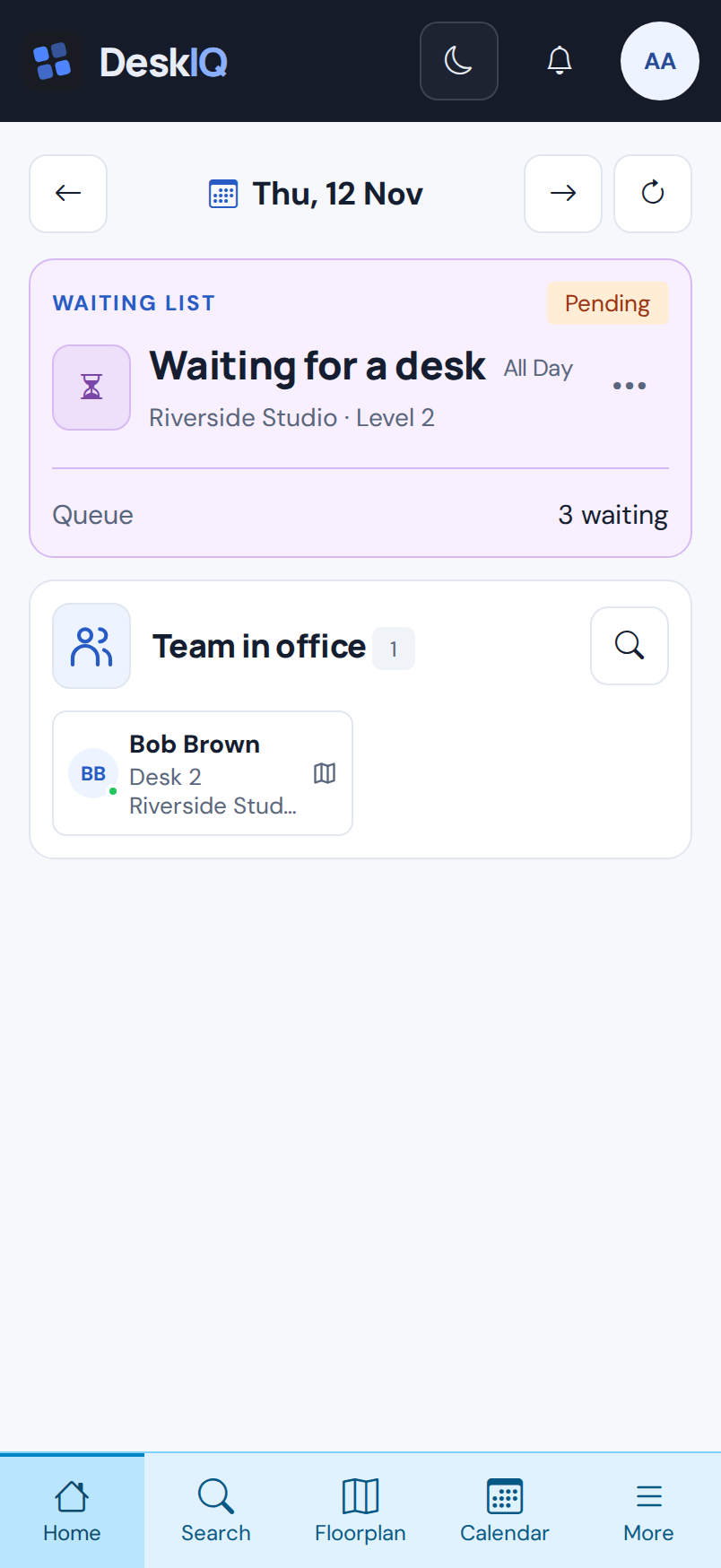
A deliberate handover
Sometimes you want to give a specific colleague your desk booking. Releasing it and asking them to rebook creates a gap: someone else can take the desk before they do.
A desk transfer provides a direct handover without releasing it into general availability first. If you simply no longer need a booking, cancel it to free the space.
Individual needs. Shared office days.
Our approach to team days is automatic: group core teammates when their office plans overlap, within their agreed preferences and constraints. The aim is to support collaboration while respecting each person's hybrid-working needs.
One week, the shared office day might be Tuesday. Another week, it might be Thursday. Grouping should follow weekly preferences and changing availability, without a new poll or confirmation task for every ordinary cycle.
A common day does not mean forcing everyone into the office. Where only part of the team overlaps, the grouping reflects that overlap. With no common day, there is no shared day to group around. Suitable space still has to be available.
Week one
Week two
No team needs to own a permanent bank of desks for this approach to work. Across many colleagues and teams, allocation has to balance changing requirements against the same shared capacity. A preferred neighbour must never override an agreed constraint.
A workplace that keeps changing
In a large hybrid workplace, individual routines and team needs rarely stand still. Permanent desk assignments and fixed team days can struggle to reflect those changes.
DeskIQ's direction is to bring individual requirements, team overlap and available space into the same allocation process. Space can serve different groups as their weeks change, while people retain routines that reflect their own needs.
The aim is collaboration without owning a bank of desks, and getting organised without winning an early-morning race.
Explore DeskIQ for organisations →For people and workplaces
For individuals
Set your routine, choose your preferences and keep room for changing plans.
Get early access ↗Explore individual benefits →For organisations
Talk to us about your team's hybrid-working patterns and the space you share.
Contact us ↗Explore organisational benefits →